- Wild Style Magazine
- Driveways and Paving
- What gravel works best for a driveway
What gravel works best for a driveway
Find out the best gravel for a driveway by learning how base layers, crushed stone, and proper drainage keep your surface solid and rut-free.
Words by Rory Sundquist6 min to read
The best gravel for a driveway is crushed angular stone packed in three distinct layers. A solid driveway needs a heavy base of large rocks. You follow this with a middle layer of medium stones. You finish with a top layer of small crushed stone mixed with rock dust.
Pouring a single type of loose rock directly onto bare dirt will fail. The stones will sink into the mud, and you will have to buy more gravel often. Building the right layers gives you a firmer surface that holds up better to vehicles and spring rain.
Why the layers matter more than the top stone
A driveway operates as a complete system where the native soil underneath acts as the subgrade. Dirt alone turns into soft mud under the weight of car tires. Piling loose gravel straight onto this topsoil creates a temporary fix. The pressure of your cars simply forces those rocks downward into the dirt over time.
Much of the structural strength comes from the hidden layers beneath the surface. Stepping down the size of the stones from bottom to top distributes the heavy load of a vehicle. A local contractor or stone supplier sets the exact depths of each layer based on your specific soil type. Soft, wet soils may need a thicker base than firm soils, which is why your supplier or contractor sets the depths.
Before you remove the topsoil to build these layers, check with your local building department. They can tell you if you need a permit to cut a new driveway entrance onto a public road. You also need to call 811 to have the utility companies mark underground pipes and wires before you dig.
Large crushed stone for the base
The first layer goes directly over the excavated soil. You want large crushed stone for this foundation. You order this rock by the cubic yard or by the ton. Dump trucks deliver the stone and spread it as they drive forward.
The manufacturing process matters because machines crush the rocks at a quarry to create sharp, angular edges. These rough edges lock tightly together when a heavy machine compacts them. Round stones slide around under pressure, but angular stones bite into the adjacent pieces. This biting action forms a rigid, interlocking foundation that supports the entire weight of your vehicles.
Your contractor sets the thickness for your soil. A heavy vibratory roller forces the jagged points into one solid mass. This coarse bottom layer also provides open space between the large rocks. Water draining under the driveway passes through these empty spaces and drains away without washing out the roadbed above.
Crushed stone with fines for the middle
The next layer steps down in size. The pieces are smaller than the base stone, and your supplier can tell you what it sells under locally. You spread this material in an even layer over the compacted base rock.
This middle section does two jobs. First, it fills in the large gaps left by the bulky base stones. Second, it creates a transition zone between the massive rocks below and the tiny surface stones above. Skip this middle layer and the small top stones will eventually fall through the wide gaps in the base.
This middle layer also contains fines, which are the tiny particles of rock dust created during the crushing process. Compact it the way your supplier or contractor advises. The fines help bind the angular stones together, which is why Penn State's center notes that losing them loosens the surface.
Top stone choices and why pea gravel rolls
The top layer is the one you see and drive on every day. Crushed stone mixed with stone dust works well here. Quarries sell it under local names such as crusher run or dense grade aggregate, so ask your supplier what they offer.
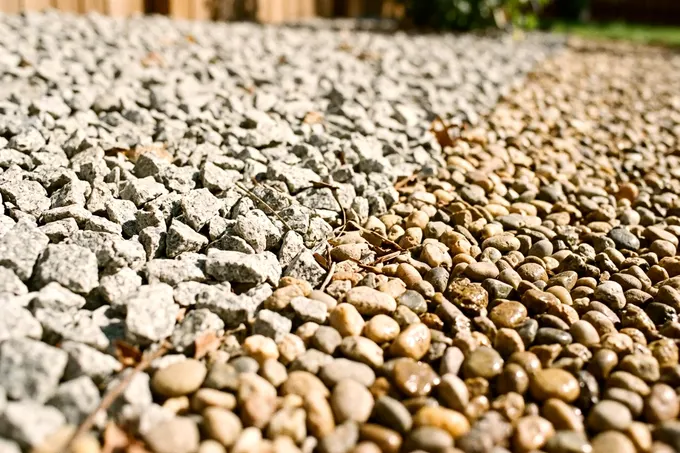
The angular pieces are very small. The heavy mix of rock dust creates a very dense surface. When a roller packs this mixture down, it forms a hard, dense surface that sheds water better than loose stone.
Many homeowners like the look of pea gravel, which consists of small, smooth, rounded river stones. Do not use it for a driveway because the smooth edges mean the stones never lock together. Pea gravel rolls under your tires just like marbles, constantly shifting out of the tire tracks and piling up in the center. You will spend hours raking it back into place, so stick with angular crushed stone for a stable, hard surface.
Fabric, crown and ditches for drainage
Water destroys gravel driveways. According to Penn State's Center for Dirt and Gravel Road Studies, standing water that soaks into an unpaved surface leaves the surface and base soft and weak. You have to control where the rain goes.
Start with a heavy woven geotextile fabric laid right on the bare, compacted dirt. You roll this fabric out before you dump the base stone. Overlap the seams as the fabric maker directs and pin the fabric down. The fabric can keep wet soil from mixing with your clean base stone.
The surface then needs a shape that sheds water. A completely flat driveway holds puddles. The Penn State center's crown diagram shows a center crown falling 1/2 to 3/4-inch per foot of width toward each edge. This steady slope forces rainwater to run off the sides.
You must give that water a place to go. Ditches on either side carry the runoff away from the roadbed. A ditch crossing a public road edge may need a culvert under the entrance, so ask your local building or highway department. If water sits in the grass right next to the driveway, it can soak under the base and soften it, as Penn State's center describes for standing water.
Edging that keeps stone off the lawn
Cars and bad weather naturally push surface gravel sideways over time. A physical border holds the loose stone in place and defines the edge of the driveway.
Heavy timbers, pressure-treated lumber or large fieldstones create a solid boundary. You dig a shallow trench along the side of the driveway to set these materials firmly in the ground. You can also install heavy-duty plastic or metal edging. You spike these flexible materials deep into the soil along the perimeter before you dump the stone.
Good edging saves you from digging tiny rocks out of your grass before you mow and gives the driveway a clean finish. If you want 11 garden edging ideas that keep beds looking neat alongside the driveway, choose sturdy materials. The border must withstand an occasional bump from a car tire. Edging also blocks soil from washing out of your flower beds and clogging the clean gravel surface.
Raking, regrading and topping up
Gravel driveways demand regular maintenance. Penn State's center says traffic, snowplowing and flowing water wear away the fines that bind coarse aggregate, pushing loose stone to the edges and trapping water on the surface.
You need to pull that displaced material back to the center crown. A heavy steel landscape rake handles small fixes by hand, and a tractor pulling a box or rear blade makes quick work of regrading long driveways. If you develop a pothole, do not just kick loose gravel into the hole. Clear out loose material first so the new stone locks in, and ask your plow operator to keep the blade slightly raised so it does not scrape off your top layer.
Every few years you may need a fresh load of top stone. This new crusher run replaces the fines that wash away in heavy rain. It also replaces the small stones that break down under truck tires. You spread the new stone, wet it down and compact it again.
For less upkeep, the EPA lists pervious asphalt, pervious concrete, interlocking pavers and plastic grid pavers as alternatives that let rain and snowmelt seep into the soil and gravel below. You can also research an asphalt or concrete driveway and how to choose between them for a permanent finish. In freeze-prone areas, consider driveway pavers that hold up under cars and winters instead of plain gravel.